Five Strategies to Make Your Online Sessions More Engaging

Since the spring of 2020, we have all come to know what online learning is. As a result of the lockdown due to the COVID-19 pandemic, schools and teaching organizations had to transfer their regular classes from traditional to virtual classrooms. To operate efficiently entirely online, the schools had to adjust all of their activities – not only the teaching and learning process, but also the handling of administrative activities, communication with parents, office hours, etc.

Before the pandemic, some of these activities had already been digitalized and automated due to SIS. Instruction, however, took place for the most part in traditional classrooms. The unexpected and immediate need to switch to online learning during the lockdown forced the teachers to use different and often incompatible tools to replicate their regular activities in an online format. After almost a year in this situation, the need for solutions that unite all face-to-face training elements in one online ecosystem has come to the fore.

Fortunately, such solutions already exist – for example, the integration of Lumen Touch (a comprehensive all-in-one school system) and VEDAMO (a virtual classroom for highly interactive real-time online teaching). The next step is to improve the methodology and practice of online instruction. The virtual classrooms’ students should not be passive receivers of information transmitted via video conferencing and shared screens. A productive and high-quality learning process requires students to be actively involved with their teacher and peers, albeit from a distance. A lesson in the virtual classroom lesson should not be like a TV show hosted by a teacher. Instead, it should provide an environment for teamwork, discussion, self-expression, sharing experiences, practicing new skills, etc. The personal contribution to the interaction is a prerequisite for increased motivation and engagement during online classes.

Here are five strategies that can make your virtual classroom teaching more engaging and effective:

  1. Collaborative activities on the whiteboard:

Тhe virtual classroom session is not and should not be a video lecture. It happens in real time and affords opportunities for active participation and collaboration between the instructor and the participants. Advanced virtual classrooms are equipped with all of the tools needed to apply collaborative learning. This pedagogical approach involves a group of students who work together to achieve a common goal, exchange views, or solve problems. In this type of interaction, the instructor’s role changes significantly – the instructor is not a lecturer but, rather, a moderator and counselor. It is a great way to turn the interaction into a partnership and encourage cooperation in skills development.

The online whiteboard in the virtual classroom is the perfect tool to engage students in collaborative activities. By using the tools for drawing, writing, editing, and presenting content on the online whiteboard, students can work together on many joint activities, such as:

  • Brainstorming
  • Creating mind maps
  • Playing or creating educational games
  • Working on a joint presentation
  • Editing content
  • Making quizzes
  • Discussing and analyzing case studies and much more.
  • Small-group activities in breakout rooms

Small-group activities are a great way to take students out of stressful large-group discussions, which often do not allow each student to participate, reflect on the learning material, and practice the new skills and knowledge. Working in smaller groups creates a more informal and relaxed atmosphere. The instructor’s role is to carefully plan and facilitate the interaction in the smaller group so that each student contributes equally towards achieving the learning outcomes.

The virtual classroom allows the instructor to separate students into breakout rooms and assign small-group activities. Breakout rooms are a separate workspace where students cannot hear or see those outside the group.

For example, suppose the virtual classroom instructor works with a large group of 20 students. In this case, the instructor can divide them into five groups of 4 students, distribute them into separate breakout rooms, and assign each group a specific task for a particular time limit. After completing their assignments, each small group can choose a presenter and report their results back to the whole class. This approach boosts student creativity, communication skills, and teamwork.

  • Flipped classroom approach

The typical scenario in the traditional classroom is that the teacher presents the lesson during class and assigns practical activities for homework. The flipped classroom has the exact opposite logic. The students prepare for the new lesson on their own by using different types of resources created or selected by the teacher – video lectures, presentations, articles, etc. During class, the focus is on practice and discussions under the teacher’s guidance. This approach stimulates more in-depth learning and skill building. This method’s practical application depends on the quality of the materials for self-preparation and the students’ motivation to work independently and prepare for the class. The instructor can trigger the students’ motivation by giving them a particular problem to solve that is related to the new study material.

The flipped classroom method can be successfully applied to online learning, especially when using a Learning Management System (LMS) with a video conferencing virtual classroom. The instructor can upload the materials for self-preparation on the LMS and assign a quick quiz for reading comprehension that students should complete before the virtual classroom session. During the real-time virtual classroom session, the instructor can engage the students in practical activities and discussions. In this way, the students will use the virtual classroom time to build on their skills by applying the new knowledge acquired independently.

  • Student-led activities

When the focus in class is on the instructor and the presented content, students usually remain passive and have little opportunity for collaboration. Student-led activities place the student at the center of the interaction. They aim to engage students in the material by giving them a leading role in the learning process. The students become the teachers – thus, they take ownership of the classroom interaction. In this way, learning becomes more meaningful and collaborative.

The virtual classroom provides the perfect environment for student-led learning. The instructor can easily create opportunities for both independent and collaborative learning. For example, the teacher can assign some of the students to make a presentation, demonstration, or a project on a specific topic. Each student will prepare in advance using available resources and guidance. During the virtual classroom session, the students and the teacher will shift their roles. The students can present part of the new lesson and engage their classmates in games, exercises, or discussions. This approach promotes peer-to-peer learning, improves the students’ presentational skills, and supports the long-term acquisition of new knowledge.

  • Gamification

Gamification is often confused with educational games or game-based learning. Gamification is an approach that applies gaming principles and techniques to the learning process; examples of gamification include collecting points, prizes, badges, etc. Usually, teachers use gamification to solve problems they encounter in their classrooms, such as issues with behavior, concentration, motivation, active participation, etc.

Gamification in the virtual classroom boosts the students’ motivation and helps them identify their strengths and weaknesses. How can the virtual classroom instructor apply it? Here are some ideas:

  • You can use the online whiteboard for weekly rankings. First, identify criteria and indicators to assess the students’ achievements during the week. Then, assign points to each indicator. Present the weekly ranking as a table on a separate whiteboard sheet. Finally, discuss the students’ progress at the end of the last virtual classroom session of the week.
  • When assigning individual work in breakout rooms, you can use an imaginary scenario and determine challenges for the students to overcome while completing their tasks.
  • You can award virtual badges for completing given tasks during the virtual classroom session. You can put images or graphic objects on the whiteboard next to the students’ work.

Gamification makes learning a fun and exciting process. It stimulates the students’ interest in mastering the new knowledge and developing skills.

With the right tools and functionalities, advanced virtual classrooms allow instructors to easily apply these strategies. They can provide significant added value to online learning by addressing student needs, individual characteristics, and preferences. Making students active and responsible participants in their own learning is one of the main factors that is taking virtual classroom instruction to the next level.


About the author:

Dr. Veronica Racheva is an education programme director at the VEDAMO company.

She is also managing various educational and social project at “Proznanie Foundation” Veronica has a PhD in Theory of Education from Sofia University. She also graduated from the Doctoral School at the Institute of Education, University of London and has a specialisation for a Virtual Teacher from the University of California, Irvine. Currently, Veronica is also a lecturer in E-learning at the Sofia University, trainer of teachers, researcher and author of scientific reports.

Hindsight 2020: A Year Filled with Hope

Do you remember what you were doing a year ago today? You might have been sending the kids off to school, driving to work, or shopping for Christmas presents. You most likely weren’t running back in to grab your mask, transforming your dining room into a work-study area for your kids, or angling your laptop just right for the light and background in your bedroom to hop on yet another zoom call. A lot can change in a year. And from our perspective, it’s a year that points to the endurance of spirit, the kindness of strangers, and the ability to transform challenge into progress.

We Will Endure

We’ve worked through challenges to overcome everything from zoom bombs to Wi-Fi inequity. Along the way, we’ve learned that teachers are wonderfully committed beyond all expectation to caring for their students – and that they can get pretty creative in finding ways to do just that – like the teacher laying on the side of the road recording an ant hill for his students using a GoPro. Or the teacher who used his stimulus check to pay his students’ utility bills. Or all of the teachers who showed up this fall – in person, online, and both – still ready to give their students 100% every day.

We Are All Innovators

The saying necessity is the mother of invention has never been more accurate. From parking buses in neighborhoods to deliver WiFi to rolling out new technology to make it easier for schools to safely track and monitor student heatlh, innovative solutions have been in abundance to help students, teachers, parents, and schools have a successful year. Nowhere has that innovation been more apparent than from the scientists who have rapidly developed multiple viable vaccines.  

Hope Is Eternal

Throughout this year, amidst the tears, frustration, and loss, there has been an underlying feeling of hope. From a renewed appreciation for the essential workers in our communities to empty pet shelters across the country, good things happened in 2020. Here are some of the highlights:

Vaccines are being distributed as we speak. Our ability to endure, innovate, and maintain hope will see us through to a BRIGHTer 2021.

Are We Ready to Emerge into 2021 and a New Universe?

by Dr. John Vandewalle

There is no doubt that 2020 has been the test of our resilience and the fight is not over. As leaders in our communities, we set the example by our mere presence and our resilience becomes the resilience of others in our circles. We often have to pinch ourselves to remind us where we are and what we are aiming for and more importantly what we are grateful for. Here are some considerations that may prod us to stay the course and allow others to follow.

For our personal wellbeing: Be mindful of our health and social welfare with considerations

  • Wash our hands as often as possible – it is good practice.
  • Consider a small bottle of sanitizer for instant access.
  • Wear a mask in front of others to show respect for them and our loved ones.
  • Keep a distance
  • Take extra precautions for those in the “at risk” groups
  • Be prepared to listen as we all have our own concerns. This will foster the community trust.
  • Keep our eyes and ears tuned for trends, information, sage input that hovers above the fray and allows us to stay ahead of the game.
  • Gather and use data to make informed decisions.
  • Share our leadership with our constituents to give them confidence and courage.
  • When all else fails, break out of our silos and reach out to our community for mutual support
  • If we are struggling, call a friend or perhaps make a new friend
  • Carry a little gift bag in your car or purse in case someone on the street can savor a small pleasure

For our organization’s wellbeing: Be mindful of our leadership and our team

  • Stay communicating – more than ever
  • Meet regularly with our teams
  • Focus on our vision, mission, goals and values
  • Recreate our plan/s and ensure they infiltrate through out
  • Revisit our plan weekly with our team as the dynamics are in flux
  • Re-recruit our team and thank them more than often
  • Pay special attention to leadership and technology
  • Be more creative and entrepreneurial than ever
  • Brake down our silos and reach out aggressively that makes us uncomfortable
  • Be the example of supporting local on all fronts
  • APPRECIATE THE HEROES OF THE MOMENT -> YOU ARE PART OF THE PARADE

DROP ME A LINE and let me know what 2021 is bringing for you.

Dr John Vandewalle, CEO Lumen Touch. email: johnv@lumentouch.com

2020 – A Year That Has Challenged Our Prowess and Resilience

Helen Keller said, “A bend in the road is not the end of the road… Unless you fail to make the turn.”

This has been a trying year for everyone, but we at Lumen Touch can’t help but end the year with a very bright outlook. Hats off to our partnering school districts – and educators everywhere – as they continue to make Herculean efforts to ensure that their students are taken care of and receive instruction, while we’ve simultaneously watched the edtech industry pull together to support teachers and schools in ways that were unexpected but most welcome. We all have embraced the bend in the road.

Lumen Touch has been fortunate to partner with several innovative companies, rising to the demands and extending the reach of our platform to provide urgent solutions to new challenges, using our Bright SUITE™ product line. This has dramatically reduced some of the constraints and frustrations that teachers and IT teams were unexpectedly confronted with. Two of these very valuable partnerships have helped us significantly impact schooling as we navigate unchartered waters.

The GG4L Digital Stimulus Package – a must for all school districts

Lumen Touch is proud to be one of the solutions offered in the GG4L Digital Stimulus Package, which gives GG4L member schools immediate deployment of a free, fully integrated digital transformation bundle, valued at over $2,500 per school. In addition to a district-branded portal and 60 days of access to Lumen Touch’s Bright CARE™, schools receive:

  • Reliable single sign-on School Passport across all apps
  • Safe online SchoolTube video sharing for all courses
  • Academic achievement self-diagnostic tools through Gooru’s Navigator
  • Secure GG4L Virtual Classrooms for all courses (60-day trial)
  • Actionable family engagement with native iOS/Android mobile app (60-day trial)
  • Hundreds of free online learning resources available from GG4L’s Catalyst catalog
  • Bright CARE for management of COVID-19

Better Health and Health Monitoring with Lumen Touch and Tesseract Ventures

Lumen Touch partnered with Tesseract Ventures, a fellow Kansas City-based technology company. Using Tesseract’s PRISM™ technology, Lumen Touch can issue badges for students, allowing the necessary tracking and tracing information to be collected while prioritizing student safety and privacy by shielding individual data from anyone without proper authorization.

Bright CARE’s tools include:

  • Temperature tracking and contact tracing
  • Tracking of COVID-19 testing
  • Monitoring of and alerting on social distancing
  • Summary of medical conditions and injuries
  • District-wide summary of immunization error dates
  • Immunization summary report by type and exemption (to include COVID-19 vaccination)

Kansas City is being recognized as a hot spot for education technology prowess. We are all better together to build an education platform that fills jobs with market-value assets – that is, students succeeding in a new learning environment. Lumen Touch and Tesseract are happy together and want to invite others to the table to develop the future in education.

– Dr. John Vandewalle

As 2021 draws near, we are grateful to have partners like these to help us better serve our schools and communities. All of us at Lumen Touch wish you a happy and safe holiday season and a prosperous 2021.

As Education Changes, Lumen Touch Changes with It

Lumen™ Touch has been in the thick of things with our partner schools since the first hint of the pandemic. The administrators, teachers, and especially, the IT directors at our schools began doing everything they could to prepare for distance learning and mitigate risk as early as last March. They’ve continued that work each day with determination. They make sure students have laptops, arranging for contactless pickup for students who didn’t go home with one. They come up with creative ways to provide access to the internet, enabling mobile hotspots in parking lots and on buses, for instance. But our industry remains in constant flux, and with the changes being thrust upon us, we must adapt accordingly.

New for the 2020-2021 School Year from Lumen Touch

You already know how we strive to protect student data and provide the kind of IT support that makes a measurable difference to every school’s data security. But we haven’t stopped there. We have been listening to the schools we work with about what really hinders their ability to keep their students safe, and our developers have been working tirelessly in response to their feedback to meet the needs of schools across the country.

Bright Care™ Rapid Screening Entry: Though health and wellness has always been at the core of our values and technology, we understand that the well-being of our students is now more important than ever. Bright Care Rapid Screening Entry allows any staff member to quickly screen student temperatures as they enter the building. This systematic and data-driven application easily allows you to monitor students and staff and carry out contact tracing. Using data coming from temperature sensors of different kinds (e.g. GoSafe), you will have another level of contactless control to manage the safety of your students and staff.

Bright Learning™ Secure Video Conferencing: We know that students learn through a variety of media and that learning ‘online’ doesn’t just mean watching videos and completing multiple-choice assessments. In a time when we cannot always be face-to-face for instruction and discussions, it is critical to be able to provide a safe, secure, interactive, and measured video software solution. For these reasons, we have worked to include not only the virtual learning video, but also, the ability to capture the engagement of students during the interactive sessions. Our secure video conferencing is an integrated video platform that can be used within the Bright Learning system to manage virtual and distance learning. By incorporating this onto our platform, we are able to better manage cybersecurity while providing features to make the new way of virtual engagement seamless and less stressful.

Lumen Touch is committed to providing the safest and most comprehensive learning solutions to meet your school’s needs – without compromising student security or education integrity. We’d love to have the opportunity to talk about how our platform can help your school. Get in touch.

It’s Time to Join SpaceX and Aim for the Moon

Our existing education system is like the rocket ship of the past that got us into orbit. That was the engine that built the economy of our very successful country.

But isn’t it past time that we build a new engine to get us to the education moon?

It took a company like SpaceX to use design thinking to reorient the US space program and bring the prowess of space adventure back to the US. They found a new design and new technology to give them the thrust and a competitive advantage.

So, have you found a new design or new technology embedded in bold leadership to embrace the passion for education redesign? This pandemic that we are in is the defining moment that is separating redesign from re-engineering. If you are caught in the crisis, it may be a good time to re-evaluate your redesign program. If you are meeting the challenge of the pandemic with some ease, then your design thinking and planning is kicking in.

How to “SpaceX” Your Education System

Let’s address the whole arena of technology and its role in managing the crisis and in leading redesign. Most technology in schools is 5-30 years old – oops! It may be important for us to define technology, so we don’t create a cohort of defensive readers.

Technology is defined as science or knowledge put into practical use to solve problems or invent useful tools.

When we mention the word technology, it is most often equated with Chromebooks, laptops, and 1:1 and curriculum software. We do not speak of it in its true context and hence will not be able to exploit it to drive the value of the brave new world, the Age of Agility, and learning tuned to the individuals’ learning abilities.

Had schools taken advantage of the existing updates in technology that are already on the market, we would now have virtual classrooms and virtual technology in every school and home, we would have been able to integrate at-home learning smoothly, and we would not be talking about inequity and inequality to the extent we are. If we had built a learning system in our community from the ground up with design thinking, then it would look unlike most schools we see today; so how do we go from here to there amid a crisis and beyond?

The Crisis-Driven Learning Revolution

The amount of money being spent on edtech technology since 2016 has skyrocketed, with a market cap for technology companies sitting at an all-time high in excess of $250 billion. Schools that embrace the integrated learning evolution discover that they can drive sustained success; high connectivity leads to high performance and streamlined learning can empower creativity. Collaboration beyond the classroom is part of the secret sauce.  Let’s rediscover what it is that we need and explore the education landscape.

If you’re interested in learning how Lumen Touch can help you and your district be ready for the present and the future of learning, please get in touch. We’re eager to show you how we can help you save time and money while improving student learning beyond the realms of our current thinking.

Is the Pandemic Bringing Us Closer to Achieving Our Moonshot or Instead Throwing Us Out of Orbit?

As Winston Churchill was working to form the United Nations after WWII, he famously said, “Never let a good crisis go to waste.”

So when we ponder the current situation we are in and embed this nasty little virus in the midst of our education redesign programs, can we scope the outcome we will be dealing with on the other side of the pandemic?

In this Age of Agility and the extension of (or often times seemingly an intrusion into) our lives as a result of technology, we have to take on new challenges and embrace technology as our partner in education.

The Challenges We’re Facing

Let’s discuss the challenges we are facing and the solutions that some are embracing to sculpt their redesign models, fostering safe, stable, and nurtured learning ecosystems that will invigorate us in our leadership positions.

Today there is no equation that provides a solution to the three-variable problem confronting us, namely, earning, learning, and mitigating personal risk. Whatever our choices are, they are unlikely to agree with the choices of those around us – and considering all the circumstances surrounding each of these parameters, there is no consensus. Even if there were, that would likely change tomorrow, because the ecosystem is a target that is constantly moving, while we spend time contemplating the past and the present. As we move through the different challenge genres, we face different sets of inequities which in turn become new challenges.

Redefining Excellence in Education

For many of us, it is natural to resist progress, due to comfort levels and brain conditioning. As the saying goes, “Why fix what’s working?” Redefining excellence, on the other hand, is hard work requiring resilience, patience, and tremendous effort that is grounded in design thinking. Strong leadership traits devoted to a vision, the mission, values, and goals form the foundation of the future state with the aspirations of a brave new world that is confluent and ahead of the times. This confluence is maintained through agility and by keeping the moonshot foremost in our minds. New heroes are created that take on a whole new life trajectory that is invigorating and tireless with the yearning for achievement on a level not experienced by the run-of-the-mill pioneer.

It only takes a crisis for us to re-evaluate.

If our vision, mission, and goals are robust, they will withstand the stress test brought about by a crisis; if not, it may mean back to the drawing board to repair the ship that may be losing altitude. Leadership and technology are the real rockets that will maintain your thrust on the way to the moon.

There are many school districts that had very robust plans in place and they managed to breeze through the crisis with very little upheaval in their systems. They progressed employing the futuristic plans already in place; these school districts were aspiring to embrace virtual learning long before the crisis occurred. They realized very early on that students adapt to different kinds of learning, and they also valued the opportunity with design thinking and project-based learning. This engrained design thinking allowed them to deploy the technology at once and accommodate the staff and the students with a new way of learning. For them, the plan was in place before the crisis, while most others were still squandering precious time creating the plan amid the crisis. The value of planning is completely underestimated in the world of education and is certainly underutilized. So, ask yourselves some these questions:

  • When was the last time I updated our organizational plan?
  • Do I hold an annual planning meeting and update my plan(s)?
  • Do I use design thinking as part of my planning program?
  • Do I engage experts for other industries to aid and abet us in our planning?
  • Do I have accountabilities or key performance indicators built into my plan that go beyond student education performance measures?

If we consider the steppingstones of design thinking, which of these steps did your organization confront in your redesign program?

Notice –> * Empathize –> * Define –> * Ideate –> * Prototype  –> * Test  –> * Reflect à *

In our next episode, we will continue this discussion on the crisis and leadership while drilling a little further down into the realms of technology.

What Should the Future of Learning Look Like?

When we start talking about what the future of learning should look like, we need to consider what the future of work will look like, too. What careers are we preparing our students for? What kinds of skills will they need to succeed – not just economically but in such a way as to advance the whole of society? If we look at the big picture, we need to begin developing a generation of tech-savvy innovators who can think on their feet and examine and analyze problems – all while having the flexibility to adjust to rapidly changing needs within their occupations, their communities, and society. The current education system is woefully inadequate to meet these needs.

From Cursive Writing to Coding?

Some schools still teach cursive writing while others are fighting to return it to the curriculum. But the future of learning is centered around STEM, programming, and robotics. Rather than teach cursive, perhaps we should focus on coding. It is a concept that can be introduced on a basic level in kindergarten and built upon through each year. Coding is the language of the future.

From Static Information to Information Filtering?

Today’s students are overwhelmed with information and little time is spent teaching them the skills necessary to determine what information is factual or how to verify legitimate sources. Perhaps not everyone needs to know calculus, algebra, or mitosis. But the future of learning could include teaching students how to manage the information with which they are inundated from every source – and how to filter that information. More emphasis could be placed on analytical thinking, fact-checking, researching, and recognizing manipulation.

Financial Literacy and Economics

Most Americans are carrying higher levels of debt than that which is considered wise. The pandemic and resulting unemployment have only made this worse, and as the likelihood of a recession or a depression looms, learning to manage money more effectively becomes a critical skill. From understanding the economy and the tax system to knowing how to budget, personal finance courses are a great addition to the curriculum.

Mental and Physical Health

From mental health and mindfulness to diet and exercise, schools can take a much bigger role in teaching students how to take better care of themselves and giving them the tools to do so. Removing stigma from mental health can occur when we make emotional and mental health a part of regular conversation. Making exercise a daily habit can start in kindergarten.

Self-Guided and Independent Learning

Should our schools be working hard to put themselves out of business? While we ask this in a very tongue-in-cheek manner, by recognizing the incredible value teachers and schools have, we can begin creating lifelong learners who can continue to develop their intellectual skills long after they leave school. Teaching students to have the discipline and analytical skills essential to independent learning ensures that their K-12 education is only the beginning. Learning how to learn is possibly the most critical skill any student will gain.

Networking and Relationship Building

One of the benefits of students being forced into distance learning last spring was that most students now have a new skill that can carry over into the workplace: the ability to network and collaborate online. From Zoom calls to working with students and teachers on projects from a distance to making presentations online, these are skills used in the workplace today. Should we not be teaching our students how to build relationships, collaborate, and network – and use the tools and technology that make it possible to do so regardless of distance?

We’re at a momentous point in education and going back to what once was just doesn’t make sense. Whether your district is resuming in-person instruction, remaining online, or developing some hybrid approach, it’s time to start introducing topics that will give students the tools they need to be competitive globally as they enter a workforce that will likely look completely different than anything any of us have seen.

The Future of Learning Is Now

Here at Lumen Touch, we are committed to providing the tools that schools need to deliver this kind of future-driven education. One of our latest efforts is a partnership with VEDAMO. We are integrating the VEDAMO virtual classroom into our Bright SUITE and Bright Student™ systems. This will allow teachers to pull scheduling from our systems into VEDAMO for the virtual classrooms, then grades will be imported into our gradebook from VEDAMO quizzes and assignments. Single Sign-On (SSO) will be a part of the integration.

If you’re interested in learning how Lumen Touch can help your teachers and district be ready for the future of learning, please get in touch. We’re eager to show you how we can help you save time and money while improving student engagement.

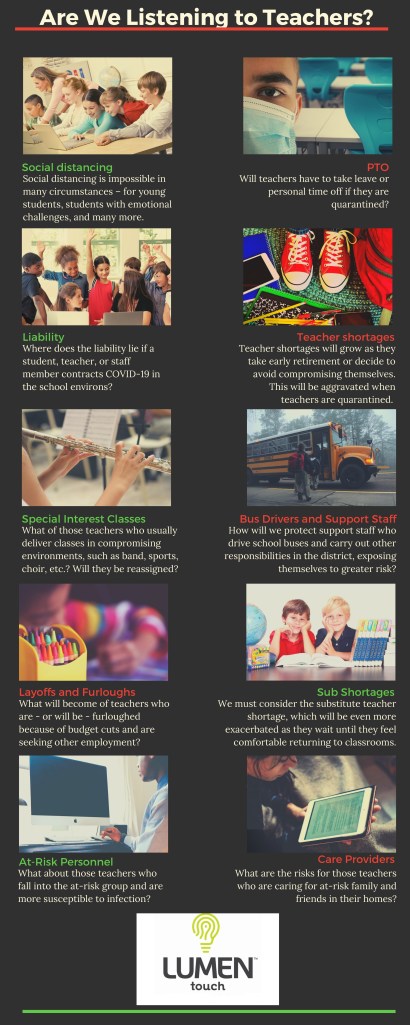
Are Teachers Unsung Heroes? Who Is Listening?

In the medical world, we have been giving a tremendous amount of praise and recognition to the doctors and nurses who have been combating the coronavirus. We are providing them with pandemic protection equipment, we are developing safety protocols, and we are paying them more to come into areas where additional help is needed.

Can we truly say we are doing the same for teachers and school staff or are we demanding they return to a work environment that will compromise their health? What are the challenges associated with going back to school? Here’s what teachers are asking about:

Many teachers are challenged with metabolic diseases, such as diabetes and obesity; respiratory diseases, such as asthma; cardiovascular diseases, such as mild heart failure; and autoimmune diseases, such as multiple sclerosis. As well, some teachers are immunocompromised patients recovering from cancer treatment or organ transplants. Do these teachers get more robust protection equipment and special assignments to reduce their risk?

So, when we go into this new world of learning, we will still be in the fog as leadership is clearly lacking when it comes to providing direction that responds to these concerns, and decision makers have different vested interests. Moreover, we have compounded the medical crisis with a social enlightening, drawing attention to mutual equity and equal education.

Our teachers have always been heroes but in most cases have gone unrecognized.

This crisis has focused a spotlight on the education system and the value of the teacher versus the institution. And guess what? The spotlight is only going to get brighter as we move into a whole new dimension of learning and unmask the travesties of our existing school systems. And this is not the time to add additional technology to fix the crisis but rather to look at what schools are trying to deliver by way of learning and realizing that their technology is not suited for the crisis and the future.

Is it reasonable to consider online-only instruction for most students?

As COVID-19 cases continue to climb in 32 states, health experts predict that schools will not truly be able to return to some semblance of normal until May or June of 2021. Knowing that, we can begin now to address the challenges of maintaining a distance-learning environment. While there were a number of hiccups in getting started with distance learning last spring, most teachers were able to overcome the challenges – as were most students. With better support to infrastructure, addressing the inequity of Wi-Fi and device access, many students can continue with distance learning. By facilitating distance learning for as many students as possible, those who really cannot remain home, whether because of financial reasons or because of special needs that require in-person therapy and guidance, can have enough space within the school facilities to be accommodated.

Lumen Touch Is Here for You – Start with our No-Cost Audit

We don’t have all the answers, but we continuously monitor the learning space and add more capability to our platform, such as integrated video and computer-based interactivity, and Covid-19 monitoring and tracking with parent, teacher, and student portals to keep everyone informed every moment of their day.

We also have a seasoned audit team that will help you find means to pay for extra costs when your budgets are being cut. This audit is at NO COST to you and has saved some districts hundreds of thousands of dollars. Get in touch to learn more.

Transforming Education Post-Pandemic

“The fact is that given the challenges we face, education doesn’t need to be reformed – it needs to be transformed.” – Ken Robinson, The Element: How Finding Your Passion Changes Everything

Transforming education is not a new topic, and it’s something the team at Lumen Touch has been working toward for a long time. Many of the things the pandemic has forced schools to contend with are those things that should have already been in place –virtual classroom technology and comprehensive connectivity, for instance.

Education Is the Driver of Economic Development

The more educated our workforce is – the more educated our community is – the better lifestyles are going to be for all workers. Income is driven by education, as is the well-being of the citizens of a community. Unfortunately, our education system has been stagnant for decades. As a result, we have fallen to 25th in math proficiency in the world; 17th in science proficiency; and 14th in reading. To turn that around we must:

  • Transform the system
  • Personalize the learning
  • Discover the child
  • Create the environment

Teachers Should Be Engaged with Every Aspect of the Transformation

We need to start listening to the teachers.

Among all the academic stakeholders, teachers are the least likely to believe their opinions count at work. But during the pandemic, and in a post-pandemic world, teachers will be much like frontline healthcare workers – the ones who can tell us what we need to survive and thrive. What do teachers want?

  • Less bureaucracy and more quality teaching time
  • Adaptations to meet individual student challenges
  • More personal accountability
  • Personal development

Ironically, if we’d have met teachers demands to have greater access to classroom-based tech before the coronavirus, the transition to distance learning would have been so much smoother.  It’s time to completely change the way we engage with teachers. They need to be part of the leadership teams and part of the decision making. They need to be part of the redesign team top to bottom, inside and out.

Leadership and Technology Will Pave the Way to a Brighter Future

The pandemic, with its disruption, is forcing us to accelerate toward where we should have already been. In other words, we don’t need to transform education because of the coronavirus – the coronavirus just forced the transformation we’ve needed for decades. We need to take the opportunity being presented.

Leadership must protect, embrace, and support agents of change. Instead of designing homogenized schools, we need to design schools that reflect our communities. Schools should be community centers, audaciously planned to utilize capacity in ways that serve everyone. Leaders must:

  • Bring design to life
  • Remove barriers
  • Create accountability
  • Prepare for pushback
  • Continuously pursue the dream

To succeed, integrated technology will be required in all aspects of school design and education delivery – in architecture, connectivity, safety, wall space, room space, site utilization, hardware and software, furnishings, and more.

Leaders must be outcome-driven, willing to do more with less; they must become moguls of data analytics and bring more stakeholders to the table, including volunteers, vendors, and business partners, for they are all part of the education community.

Now is the time to shift the curve – from classroom batching to personalized engagement; from brick-and-mortar to project-based virtual learning; from the family to the community; from empowered administration to empowered students and teachers; from textbook to device; from analog to digital; from teaching to wellbeing; from grades to learning trajectory – from INSTRUCTIVISM to CONSTRUCTIVISM.


Lumen Touch is dedicated to being part of the future of education. We focus on improving the learning opportunities for children with measurable outcomes. We have been diligently listening to educators and experts to develop and improve our all-in-one solution. We’re discovering through this pandemic how critical it is to have something like Lumen Touch in place for a seamless transition from the classroom to home education without missing a moment. In a potential hybrid-style future, in which split schedules are the norm and education time is divided between school and home, this is critical. We are in the process of expanding our services to all 50 states. If your school is preparing for a permanent change in instruction and delivery, get in touch.